

People call it “daycare” like it’s just a place to park your child for a few hours.
That’s not what good care is. Not even close.
A strong child care centre in Canning Vale becomes part of your family’s operating system: it steadies your week, supports your child’s development in very real ways, and, quietly, makes work, study, and life feel less like a constant scramble. And yes, there are centres that look fine on the surface but don’t deliver once the novelty wears off (I’ve seen that play out more than once).
The real reason local care matters (and it’s not convenience)
Local convenience is nice. But the deeper benefit is continuity.
When your child attends a child care centre in Canning Vale, routines get tighter: consistent drop-off rhythms, familiar educators, fewer car-meltdowns, and less rushed handover energy. That consistency shows up in behaviour, sleep, appetite, transitions, social confidence. It’s not magic; it’s predictable environments doing their job.
From a specialist lens, early childhood settings influence:
– attachment security (how safe kids feel with adults outside the home)
– language exposure and conversational turn-taking
– executive function: attention, impulse control, flexible thinking
– social problem-solving in groups
Those aren’t fluffy concepts. They’re the building blocks of later school readiness and mental health.
Hot take: if the centre doesn’t communicate well, it’s not “high quality”
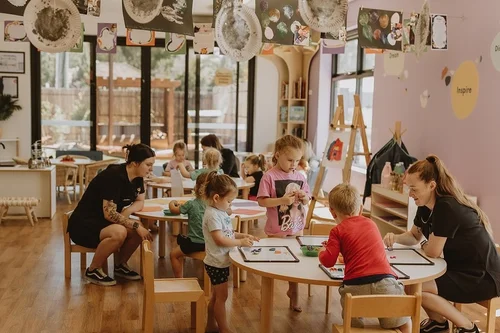
You can have gorgeous rooms, shiny playgrounds, and a fancy menu board.
If communication is vague, defensive, or inconsistent, you’re gambling with your child’s experience. A reliable centre doesn’t just “update the app.” Educators actively partner with families: quick check-ins, honest context when a child is having a hard phase, and follow-through when you raise concerns.
Look, parents can tell when they’re being managed instead of respected.
A centre that takes collaboration seriously will usually have:
– clear educator handovers at drop-off and pick-up
– documented learning notes tied to developmental outcomes (not just cute photos)
– calm, prompt responses when something goes wrong
– consistent expectations across rooms so kids aren’t constantly re-adjusting
Short version: you should feel informed, not placated.
Work, study, shift life: the boring logistics that matter a lot
Some families need long-day care. Others need part-time. Some need care that doesn’t collapse the moment a roster changes.
Nearby centres can reduce friction in three practical ways:
1) Flexible hours that don’t punish you for having a real job
If drop-off and pick-up windows are tight, your whole day becomes a negotiation, traffic, meetings, late buses, sudden overtime. When a centre builds flexibility into its operations (without chaos), parents can actually plan weeks ahead instead of living in reactive mode.
2) Study breaks that are genuinely usable
Now, this won’t apply to everyone, but if you’re studying, TAFE, uni, professional courses, short, dependable blocks of care are gold. You don’t just need time; you need time you can trust. That’s what reduces stress: not wondering if you’ll get pulled out of an online exam because care fell through.
3) Reliability that stabilises your household
If care is unreliable, everything downstream breaks: attendance, work performance, income stability, and even your child’s mood. Kids feel uncertainty too. A dependable centre reduces that background tension you’ve probably normalised.
One-line truth: unreliable care is expensive in ways your invoice won’t show.
What “early learning” should look like (not worksheets, not chaos)
Quality early learning is structured, just not in a rigid, schoolish way.
Development through play, but with intent
Play is the vehicle. Educators are the steering wheel.
In strong Canning Vale centres, play isn’t random toy time. It’s planned experiences that build motor skills, language, problem-solving, and social negotiation. You’ll see sensory activities, construction play, imaginative role-play, and small-group projects that teach patience and turn-taking (and yes, conflict resolution, because toddlers are tiny negotiators with no diplomacy training).
In my experience, the clearest sign of quality is this: educators can tell you why an activity matters, not just what the kids did.
Early literacy foundations done properly
Early literacy isn’t pushing reading too early. It’s building the prerequisites:
– rich vocabulary through conversation and stories
– phonological awareness (rhymes, syllables, sound play)
– print concepts (books have a front, words go left to right)
– attention and listening stamina
Here’s a useful stat that grounds the “talk to your child” message in evidence: a large study of young children found that the number of adult-child conversational turns is strongly associated with language development outcomes. Source: Gilkerson et al., Pediatrics (2018), “Language Experience in the Second Year of Life…” https://pubmed.ncbi.nlm.nih.gov/29483215/
A good centre builds those conversational turns into the day, not just at group time, but during meals, transitions, and play.
Social-emotional growth: the part parents feel at home
This is where families notice change fast. Better emotional regulation. Less explosive frustration. More “I can do it” confidence.
High-quality centres teach:
– naming feelings (not just “stop crying”)
– repairing peer conflict (“what can we do to fix it?”)
– calm routines that reduce overstimulation
– independence skills that make home life smoother too
And when educators are stable and responsive, children settle. Faster. Deeper.
Safety and ratios: the unsexy stuff you must interrogate
I’m going to be blunt: “We’re very safe” is meaningless unless the centre can explain how.
Ask to see how they handle:
– supervision zones outdoors (who watches where?)
– headcounts and transitions
– incident reporting timelines and parent notifications
– allergy and anaphylaxis procedures
– visitor entry and sign-in controls
– sleep checks for babies and toddlers
Also ask about educator-to-child ratios and staffing consistency. The legal minimum is one thing; the lived reality is another. If they’re constantly using casuals to plug holes, children feel it, and behaviour often reflects it.
(And yes, you’re allowed to ask direct questions. You’re not being difficult. You’re being a parent.)
Meals, routines, and the quiet power of a predictable day
Nutrition sounds small until you’re trying to get a picky eater through a growth spurt while also doing a 7:30am drop-off.
Centres that do meals well reduce family stress. Balanced food, allergy-aware planning, consistent mealtimes, and educators who don’t turn lunch into a battleground, it all adds up. Same with rest time routines: a centre that treats sleep as a skill supports regulation and learning across the entire afternoon.
Here’s the thing: children learn best when their bodies feel safe and steady.
Community benefits aren’t a brochure line, they’re real
Local centres can shrink commute times, which is immediately meaningful, less traffic stress, more time at home, fewer rushed mornings.
There’s also an economic effect that gets overlooked: when parents can work consistently, household income stabilises, employers get more reliable staff, and local services benefit. Child care is infrastructure. Not glamorous infrastructure, but absolutely core.
And socially? Centres become mini-networks. Parents share tips, swap resources, recommend speech therapists, lend a hand when someone’s sick. That’s community cohesion in practice.
Choosing a Canning Vale centre: what I’d check before enrolling
Some advice is too generic to be useful, so here’s a tighter filter.
Watch the room before you read the brochure
During your visit, pay attention to tone and movement:
– Are educators down at children’s level, or managing from across the room?
– Do children look busy and engaged, or restless and unmanaged?
– Is the environment calm even when it’s loud? (big difference)
– How do educators respond to conflict: punish, distract, or coach?
Ask questions that reveal their real systems
Try:
– “How do you support a child who’s struggling with separation anxiety?”
– “What happens if a child bites or hits?”
– “How do you share learning progress, what will I see week to week?”
– “Who prepares food and how do you manage allergies?”
– “How long have most educators been here?”
If answers are fuzzy, you’ve learned something.
Trust your read, but verify it
A warm vibe matters. So does evidence. Policies, routines, qualifications, clear communication, stable staffing, and an environment that matches your child’s temperament.
Because the best centre isn’t the fanciest.
It’s the one that consistently shows up for your child, and for you, when real life gets messy.